
7 Steps to Plan a Pastor Appreciation Month with Print and Social Media Support

Pastor Appreciation Month can sneak up on even the most organized church. One week you are talking about “doing something nice,” and the next week someone needs a program, a flyer, a gift table, a run of service, and three announcements ready by Sunday.
A strong appreciation month does not have to feel rushed. With a clear plan, your church can honor the pastor and pastoral family with care, beauty, and order. The goal is simple: make gratitude visible, help the congregation take part, and create a service that feels personal rather than thrown together.
Many churches observe Pastor Appreciation Month in October, though some choose another time that works better for their calendar. These seven steps will help you plan the month, prepare print pieces, create social media posts, and follow up well after the appreciation service.

1. Start with prayer, purpose, and a small planning team
Before choosing colors, ordering programs, or writing announcements, decide what the church is trying to communicate.
Pastor appreciation should not feel like a performance. It should feel like sincere gratitude. A clear purpose helps every detail match that spirit.
Start with a short planning conversation around questions like these:
What do we want our pastor and pastoral family to feel?
Will we honor one pastor, the full pastoral staff, or ministry leaders as well?
Will the celebration last the full month, one weekend, or one main Sunday?
What parts of the congregation should be invited to participate?
What budget is available for print pieces, gifts, food, decor, and media?
Keep the planning team small enough to make decisions. A group of three to six people usually works well. Include someone who understands the church calendar, someone who can coordinate volunteers, someone who can handle design or printing, and someone who can communicate with ministry leaders.
Pick one person to serve as the main coordinator. This prevents the common problem of five people giving different instructions to the printer, musicians, ushers, and announcement team.
A simple theme can also help. It does not need to be clever. Phrases like “Thank You for Shepherding Well”, “Honoring Faithful Service”, or “Grateful for Our Pastor” are easy to use across programs, flyers, slides, and social posts.
2. Build the timeline before you build the materials
The best print and marketing materials come from a real schedule. If the date, speakers, colors, and service order keep changing, every flyer and program will need edits.
Work backward from the appreciation service date. If the main service is on the second or third Sunday of October, begin planning at least four to six weeks ahead when possible.
Here is a practical planning timeline.
Time before service | What to complete |
6 weeks out | Choose the date, theme, budget, and planning team |
5 weeks out | Confirm speakers, music, gift plan, and meal or reception details |
4 weeks out | Draft flyer copy, announcement copy, and social post schedule |
3 weeks out | Finalize program order, collect photos if using them, and approve designs |
2 weeks out | Print flyers, order programs, prepare slides, and assign volunteers |
1 week out | Review the run of service, confirm all materials, and test media files |
Service week | Set up displays, print last-minute inserts, and brief the team |
Give every major item an owner. Do not write “someone will handle flyers.” Write the person’s name next to it. Shared responsibility sounds nice, but clear responsibility gets things finished.
Also decide who has final approval. For most churches, the appreciation team should avoid asking the pastor to plan their own celebration. If approval is needed, ask a trusted church leader or administrative contact to review details without spoiling meaningful surprises.
3. Choose a theme and message that works everywhere
A good theme should work in four places:
Sunday announcements
Printed flyers
Service programs
Social media posts
Welcome slides or lobby signs
If the theme only works on a poster but sounds strange when spoken aloud, simplify it.
Your core message should answer three questions.
Who is being honored?
Use the pastor’s preferred name and title. If honoring a pastoral family, ask how names should appear. Accuracy matters.
When and where is the service?
Include the date, time, church name, and location for public-facing materials. If the event is for members only, say that gently in internal church communication.
How can people participate?
This is where many churches miss an opportunity. People want to show love, but they need direction. Invite members to bring cards, write a note, contribute to a gift, record a short video, join a choir, help with reception food, or attend the service.
Here is a sample announcement you can adapt:
Join us as we honor Pastor Appreciation Month on Sunday, October 13, during our morning worship service. We will take time to thank Pastor and the pastoral family for their faithful care, teaching, prayer, and leadership. Members are invited to bring a card or note of encouragement and join us for a reception after service.
Keep the tone warm and specific. Avoid making the pastor sound like a celebrity. The language should honor faithful service, spiritual care, sacrifice, teaching, prayer, and love for the congregation.
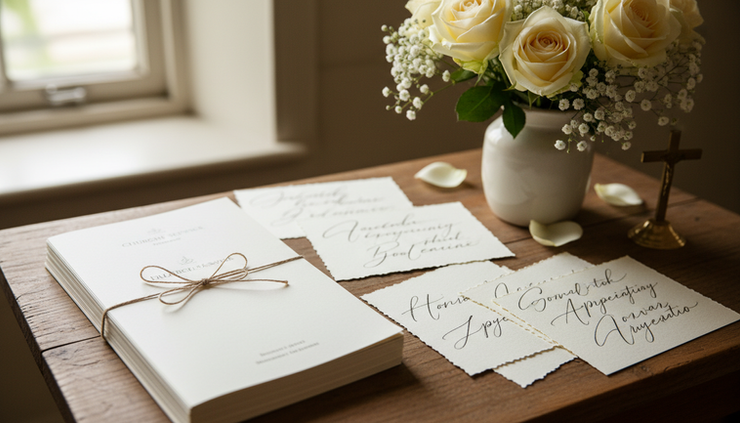
4. Create printed materials that guide people clearly
Print still matters in church life. A flyer on the bulletin board, a program in someone’s hand, and a card insert in the worship folder can all help people take part.
For Pastor Appreciation Month, focus on print pieces that serve a clear purpose.
Flyers should announce and invite
A flyer should be easy to understand in five seconds. Include the theme, honoree, date, time, location, and participation details.
Use a clean design with strong contrast. Avoid crowding the flyer with too much text. If your church has older members, make the font large enough to read from a short distance.
Good flyer locations include:
Church lobby
Welcome center
Fellowship hall
Classroom doors
Restrooms, if your church uses announcement frames there
Community board, if the service is open to guests
If you print half-page flyers, they can also be handed out after service or placed in bulletins.
Programs should support the service
The appreciation program is not just a keepsake. It helps the congregation follow the service and understand the moment.
A simple program may include:
Cover with theme, date, church name, and pastor’s name
Order of service
Names of participants
A brief pastor bio or ministry note
A thank-you message from the church
Short notes from ministry leaders or family, if appropriate
Reception details
Space for personal notes, if desired
Do not overload the program with long letters. One strong paragraph often means more than three pages of repeated praise.
Inserts should invite action
If you want members to write notes, give toward a gift, or share a memory, create a small insert. Make it simple.
Examples include:
“Write a note of encouragement and place it in the basket in the lobby.”
“Share one way Pastor’s ministry has blessed your family.”
“Join us for a reception in the fellowship hall after service.”
Print can remove confusion. Clear materials help people respond without needing extra instructions.
5. Plan social media posts that build participation
Social media can help your church remind people, share the theme, and invite participation during the weeks leading up to the service. Keep the posts warm, respectful, and easy to share.
A simple schedule works better than a flood of last-minute posts.
Four weeks out
Announce the date and theme. Use a warm photo of the church building, sanctuary, or a simple graphic with the event details.
Sample caption:
This October, we are taking time to thank God for our pastor and pastoral family. Join us for our Pastor Appreciation Service on Sunday, October 13, at 10:30 a.m. Bring a card or note of encouragement as we honor faithful service and care.
Two weeks out
Remind the congregation how to participate. Focus on cards, notes, gift contributions, choir involvement, reception help, or attendance.
Sample caption:
Pastor Appreciation Month is a special time to show gratitude. One simple way to take part is to write a personal note of encouragement. Cards can be placed in the basket in the lobby through Sunday, October 13.
Week of the service
Post a clear reminder with date, time, and reception details.
Sample caption:
This Sunday, we will honor our pastor during morning worship. Please join us for a meaningful time of gratitude, prayer, and fellowship. A reception will follow in the fellowship hall.
After the service
Share a thank-you post, but avoid posting anything that feels too private. Get permission before sharing close-up photos of individuals, children, cards, or personal gifts.
Good post ideas include:
A photo of the decorated appreciation table
A sanctuary photo before service
A group photo, if everyone has agreed
A simple thank-you graphic
A short recap of the day
Protect the pastor and congregation by using good judgment. Not every special moment needs to be online.

6. Coordinate the appreciation service with care
The service should feel worshipful, organized, and personal. A crowded program can make the day feel long, so choose each element with care.
Common service elements include:
Scripture reading
Prayer for the pastor and family
Special song or choir selection
Short tribute from a church leader
Testimony from a member or ministry representative
Gift presentation
Sermon from a guest speaker, if planned
Reception announcement
Keep spoken tributes brief. Ask each participant to stay within a set time. A three-minute message with one specific story often carries more weight than a long speech with general compliments.
If children or youth are involved, give them a clear, simple role. They might present flowers, recite a short thank-you, sing, or hand the pastor a basket of cards.
Plan the physical flow of the service too. Decide:
Where the pastor and family will sit
Who will call them forward
Who will hold microphones
Where gifts, flowers, or cards will be placed
Whether photos will be taken before, during, or after service
Who will guide guests to the reception
Print the run of service for everyone involved. Musicians, ushers, media volunteers, speakers, and hospitality workers should know what comes next.
If you are showing slides, make sure names are spelled correctly. Test every image and announcement before Sunday morning. Small errors are common when teams rush, and they stand out during a special service.
7. Prepare the reception, gifts, and personal touches
The reception often gives people the best chance to speak with the pastor and family. Keep it warm, simple, and easy to manage.
You do not need an elaborate banquet unless that fits your church culture and budget. Coffee, punch, cake, fruit, finger foods, or a simple meal can all work.
Assign volunteers for:
Room setup
Food drop-off and labeling
Serving
Trash and cleanup
Gift table oversight
Card collection
Photo area, if used
A gift from the church should match the pastor’s needs and the church’s ability. Some churches give a love offering, vacation support, books, a framed photo, a personalized keepsake, dinner gift cards, or something connected to the pastor’s hobbies. If the pastor has a family, include them in thoughtful ways.
Personal touches often mean the most. Try one of these:
A basket of handwritten notes
A memory book from members
A video with short greetings from different ministries
Children’s drawings
A prayer card signed by the congregation
A printed photo from a meaningful church moment
Set up a card station in the lobby for people who forgot to bring one. Provide blank cards, pens, and a small sign with a simple prompt:
Write one sentence of encouragement for Pastor and the pastoral family.
That one sentence can become a lasting gift.

Bonus steps to take after the appreciation service
The work is not finished when the last plate is cleared. A thoughtful follow-up helps the church close the event with care and learn for next year.
Send thanks to everyone who helped
Within a week, thank the volunteers, speakers, musicians, hospitality team, decorators, media team, and anyone who contributed food or gifts. A short text, email, or handwritten note is enough.
Be specific when possible. People are more likely to help again when they know their work mattered.
Share a respectful recap
Post a thank-you message in the bulletin, church email, or social media. Keep it simple.
Example:
Thank you to everyone who helped make our Pastor Appreciation Service a meaningful day. We are grateful for each card, prayer, gift, song, dish, and word of encouragement shared with our pastor and pastoral family.
If you share photos, choose images that honor the day without exposing private moments. Ask before posting close-up images of children, personal notes, or emotional moments.
Gather cards, photos, and keepsakes neatly
Do not hand the pastor a messy pile unless that is the only option. Place cards in a basket, box, binder, or gift bag. If notes were collected on inserts, organize them in a folder or memory book.
If someone took photos, save them in one place and decide which images can be shared with the pastor and which can be used publicly.
Review what worked and what should change
Hold a short team review within two weeks. Keep it practical.
Ask:
Did we start early enough?
Were the print materials clear?
Did people understand how to participate?
Was the service too long, too short, or just right?
Did the reception flow well?
What should we repeat next year?
What should we avoid next year?
Save the program, flyer, captions, service order, vendor information, and timeline in a shared church file. Next year’s team will thank you.
Keep appreciation going beyond one month
Pastor appreciation should not become one annual burst of gratitude followed by silence. Encourage the church to keep showing care throughout the year.
That can look like:
Praying regularly for the pastor and family
Respecting rest days and family time
Sending notes after difficult seasons
Celebrating ministry milestones
Offering help during busy church periods
Speaking encouragement, not only concerns
A well-planned appreciation month is a gift. A culture of steady encouragement is even better.
Pastor Appreciation Month gives the church a chance to pause and say what often goes unsaid. With a clear timeline, thoughtful print materials, simple social posts, and careful follow-up, the celebration can feel both organized and heartfelt. Start early, keep the message sincere, and let every detail point back to gratitude.


Comments